

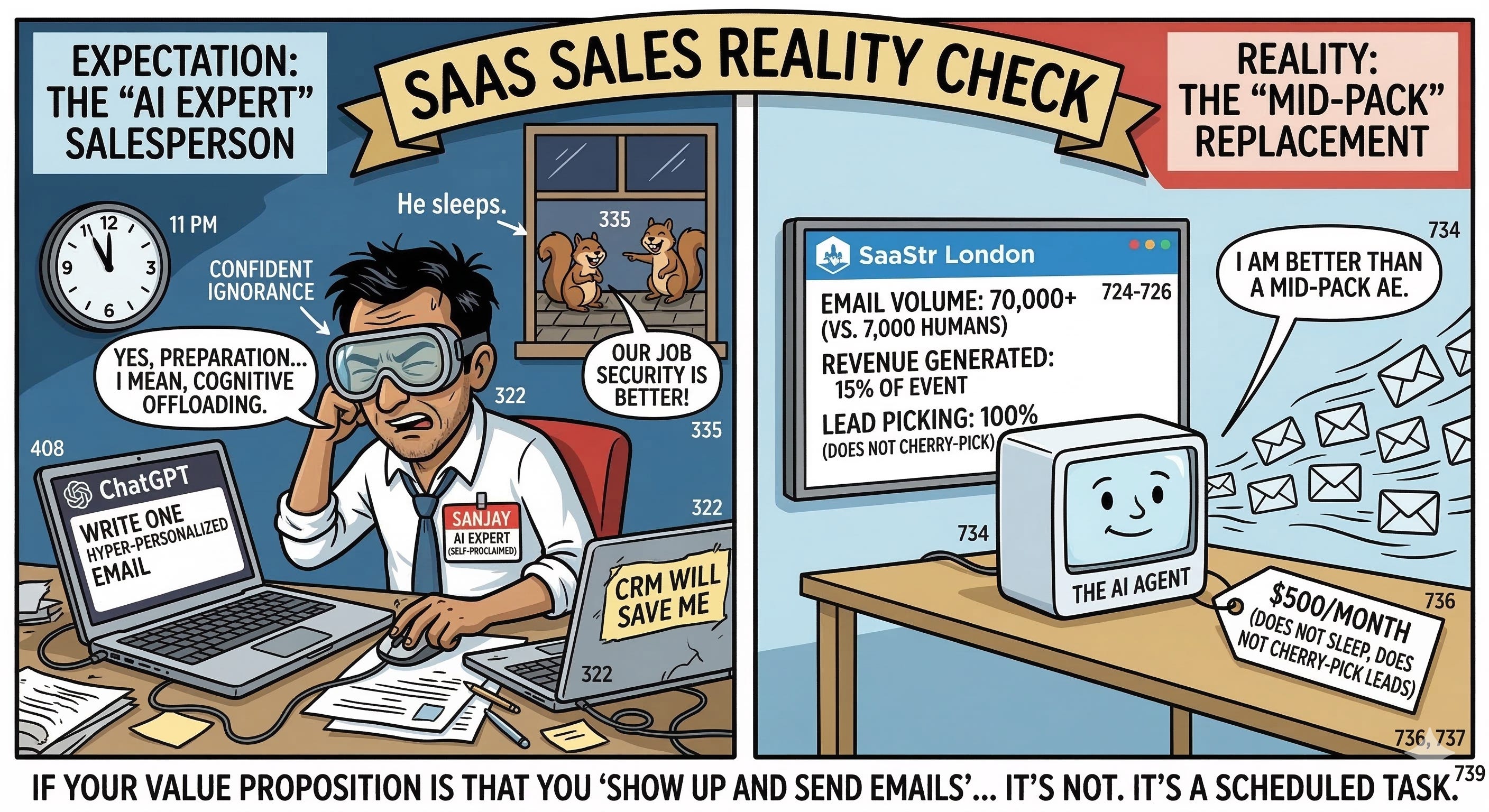
Disclaimer: It’s a super long article with some real insights and suggestions in second part. The best time to read it is when you are lying in the bed at night and doomscrolling your social media feeds. Also, in this article, I focus on Salespeople first and will follow through on my own kind (Product Managers and Engineers) in the next version when I complete my research and reading about it.
The Man Who Scored Every Job in America (Then Deleted It)
Andrej Karpathy does not post hot takes. He was a founding member of OpenAI, Tesla’s head of AI, and now runs Eureka Labs, an AI education company. When he ships something, you stop and pay attention.
On March 15, 2026, Karpathy published a project on GitHub called, simply: jobs. Within hours, it was gone from his website. The original page at karpathy.ai/jobs was deleted the same day. But not before it was archived. You can still see it at the Wayback Machine.
The project scraped all 342 occupations from the US Bureau of Labor Statistics (BLS, the government agency that tracks employment and job growth across every sector of the American economy) Occupational Outlook Handbook. It used a large language model to score each occupation’s AI exposure on a scale of 0 to 10. Area of each block in the interactive treemap is proportional to employment. Color runs from green (safe) to red (exposed). Below is a recreation of the map focused on sales-adjacent roles.
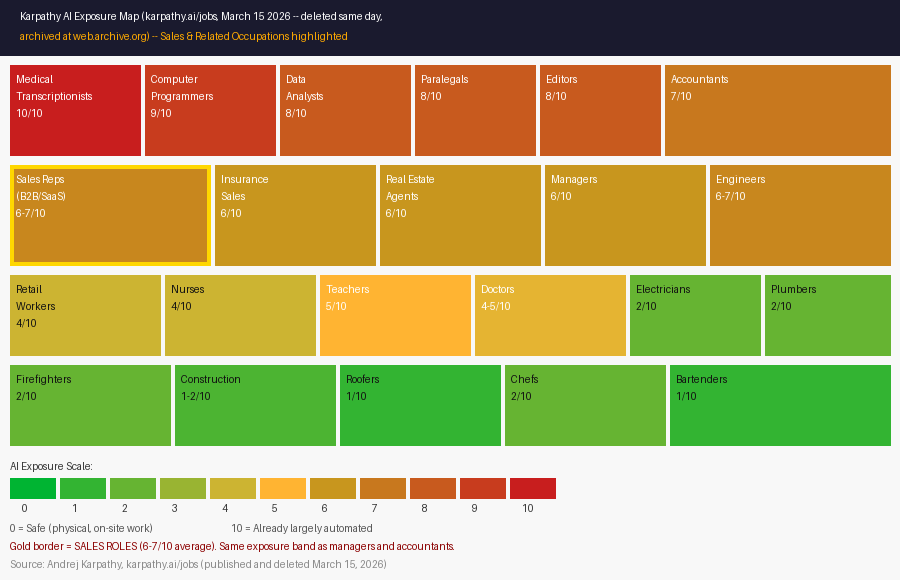
Recreation of Karpathy’s AI Exposure Treemap (karpathy.ai/jobs, published and deleted March 15, 2026, archived at web.archive.org). Gold borders indicate sales roles. Score 6-7/10.
The scoring logic is honest and specific. The key signal: if a job can be done entirely from a home office on a computer, AI exposure is inherently high. If a job requires physical presence, manual skill, or judgment that cannot be replicated on a screen, there is a natural barrier.
Here is the full scorecard. Read it carefully.
Roofers: 1 out of 10. The squirrels on your roof have better job security right now than the average sales development rep.
Plumbers and electricians: 2 out of 10. No amount of compute will snake your drain.
Registered nurses: 4 to 5. Physical presence. Real-time life-or-death judgment. A natural barrier.
Sales representatives (B2B and SaaS): 6 to 7 out of 10. High exposure. The same bracket as managers, accountants, and engineers.
Software developers: 8 to 9. The people building the tools are also being consumed by the tools. Poetic.
Medical transcriptionists: 10 out of 10. Already gone. The job title still appears in some org charts the way fax machine does in some offices.
The average AI exposure score across all 342 occupations is 5.3 out of 10. Sales sits comfortably above average. The reason sales scores 6 to 7 is not because an AI is about to walk into a boardroom and shake hands. It is because most of what salespeople spend most of their time doing is deeply digital. Cold emails. CRM updates. Proposals. Sequences. Research. Lead qualification. Forecasting. Every one of those tasks fails the screen test.
Karpathy’s scoring also factors in both direct automation, meaning AI does the work outright, and indirect displacement, meaning AI makes a smaller number of humans so productive that fewer total headcount is needed. Sales is being hit by both. Simultaneously. From opposite directions. We will get to the data shortly.
“The most valuable skill won’t be coding. It will be communicating with AI.” -- Andrej Karpathy
The implication for salespeople is precise. The ones who survive this wave are not the ones who use AI the most. They are the ones who communicate with it best, feed it the right context, catch it when it is wrong, and bring genuine judgment to everything the model cannot handle. Most salespeople today are doing none of that. And there is a specific psychological reason why.
Anthropic Just Published a Warning. About Its Own Product.
On March 5, 2026, Anthropic’s own economists, Maxim Massenkoff and Peter McCrory, published a research paper titled Labor Market Impacts of AI: A New Measure and Early Evidence. The full paper is also available as a PDF download.
A company publishing research about the economic disruption caused by its own product. That is worth pausing on. It would be like a cigarette company funding the first serious lung cancer study. Except in this case the company is not hiding the results. It is building an early warning system.
What the paper actually measures
Previous AI-and-jobs research only measured theoretical capability: which tasks could an LLM theoretically perform? Massenkoff and McCrory went further. They built a new metric called observed exposure, which combines theoretical capability with actual real-world usage data from Claude. This is the first measure of its kind: not what AI could automate, but what is already being automated in professional settings right now.
The gap between those two numbers is enormous. And it is the gap that matters most.
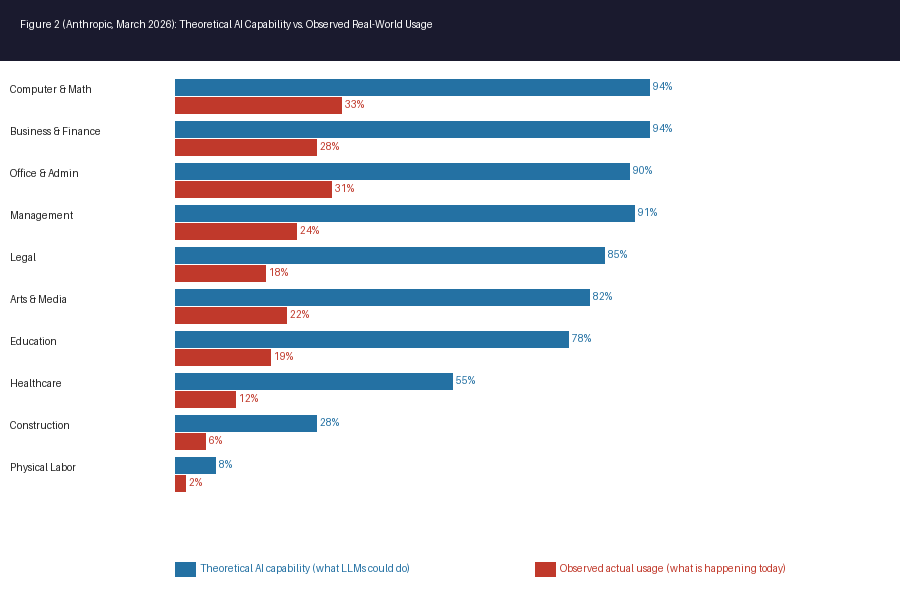
Recreation of Figure 2 from Anthropic’s March 2026 paper: Theoretical AI capability (blue) vs. observed real-world usage (red) by occupational category. Source: anthropic.com/research/labor-market-impacts
Look at the gap between blue and red in every single category. Business and finance: 94% theoretical capability, but actual observed AI coverage today is a fraction of that. Office and admin: 90% theoretical. Management: 91%. Computer and math: 94% theoretical, only 33% actual.
That gap is not a sign that things are fine. It is a description of what is coming as capabilities improve and adoption deepens. The red area will grow toward the blue. It is not a question of whether. It is a question of when.
What the BLS projections confirm
The BLS publishes employment projections covering predicted changes in every occupation from 2024 to 2034. The Anthropic paper cross-referenced those projections against the observed exposure scores. The finding is direct: for every 10 percentage point increase in AI task coverage, the BLS projected job growth drops by 0.6 percentage points. Two completely independent methodologies pointing at exactly the same thing.
The paper also identifies who is most exposed. Workers in the top quartile of AI exposure are more likely to be female, more educated, more highly paid, and almost four times more likely to hold a graduate degree. This is not replacing the warehouse floor. It is replacing the office floor. Quietly. In ways that are hard to see in aggregate unemployment data until the effect becomes undeniable.
The paper notes that unemployment in exposed occupations has not yet risen sharply. Massenkoff and McCrory are clear about what this means: the effect has not yet shown up in the most lagging indicator available. But job postings for highly exposed roles have already slowed, and hiring of workers aged 22 to 25 in exposed occupations has already declined by 6 to 16 percent, driven primarily by companies simply not backfilling roles when people leave.
“By laying this groundwork now, before meaningful effects have emerged, we hope future findings will more reliably identify economic disruption than post-hoc analyses.” -- Massenkoff and McCrory, Anthropic, March 2026
That is academic language for: we are setting up the instruments before the earthquake hits, not after. If the paper does not make you at least slightly uncomfortable about your current skill set, read it again.
Meet Sanjay
Sanjay is a B2B SaaS Account Executive (AE) -- a sales executive responsible for managing and closing deals with business clients -- at a mid-market DevOps platform. Five years in. He hit quota in 2022. Missed it in 2023. In 2024, he described himself as finding his groove, which is the professional equivalent of saying your flight is delayed but the lounge has decent samosas.
It is Q1 2026. Sanjay walks into his QBR with the energy of a man who has just discovered a life hack. He opens his MacBook. He says: I have been really leaning into AI in my workflow.
Priya, his VP of Sales, looks up. She is cautiously optimistic. She has seen fourteen QBRs in three years and has developed the particular expression of someone who has heard the words lean into used professionally approximately four hundred times. Tell me more, she says.
I use Claude and ChatGPT to research prospects before calls, Sanjay says. I pull their LinkedIn, their company website, recent press releases, drop it all into a chat, and get a brief. Takes me fifteen minutes instead of four hours.
Priya nods slowly. And what do you do with the brief?
I use it in the call.
How?
A pause. The kind that has its own weather.
I read through it before the call.
Priya sets down her coffee. Sanjay, your deal conversion dropped fourteen percent last quarter. Your discovery calls average twenty-two minutes. Your champion map on your top three open deals has one name on it and that person left the company in January. So what exactly is the AI helping you with?
Sanjay opens his mouth. Closes it. Opens it again. The Slack notification that dings in the background goes unchecked. It senses this is not the moment.
Here is the precise thing Priya understands that Sanjay does not. Sanjay is not lazy. He is not dumb. He thinks he is using AI. He is actually outsourcing his brain to a machine that makes things up and does not feel bad about it.
To understand what went wrong, you need to go back twenty years. In 2005, being good at Google was a genuine skill. You learned which results to trust. You developed a feel for credible sources. You clicked through twenty links over four hours, read them, synthesized the conflicting information yourself, and applied your own judgment to figure out what was true and what was noise. The process had friction. And that friction forced thinking.
Then comes 2026. Sanjay drops a company name into Claude and gets a polished, confident brief in ninety seconds. It has headers. It has bullet points. It reads like analysis. And some of it is wrong. The funding round it mentions may be eighteen months old. The product feature it highlights may have been deprecated last quarter. The competitive concern it flags may apply to a different company in the same sector with a similar name. Sanjay cannot tell which parts are wrong, because he did not build the understanding himself. He received a finished product and called it preparation.
COGNITIVE OFFLOADING (noun): The practice of delegating memory and reasoning to an external tool or system to reduce mental effort. Humans have always done this to a degree -- writing notes, using calculators, trusting GPS. The psychological danger arrives when the external system is confidently wrong and the person has lost the habit of verifying. Studies show that AI tools create a particularly acute form of this problem: the output looks authoritative, reads fluently, and provides no visible signal of the errors embedded within it. The result is not just ignorance. It is confident ignorance, which is considerably more dangerous.
Researchers at Aalto University published a study in the journal Computers in Human Behavior in late 2025 that made this very specific. When people use AI tools to solve problems, everyone overestimates their own performance afterward. But the researchers found something that should keep every AI-enthusiast salesperson up at night: the more AI-literate the person, the more overconfident they become. The classic Dunning-Kruger effect, where incompetent people overestimate their abilities, does not just vanish when AI is involved. It actually reverses.
“When it comes to AI, the Dunning-Kruger effect vanishes. In fact, what’s really surprising is that higher AI literacy brings more overconfidence.” -- Professor Robin Welsch, Aalto University, Computers in Human Behavior, 2025
Sanjay is not the exception. Sanjay is the research subject. He has gotten good at using the tools. He has gotten good at producing plausible-looking outputs. He has not gotten good at knowing when the plausible-looking outputs are wrong. And in sales, where a single inaccuracy about a prospect’s business can end a call in four minutes, that gap is expensive.
The Numbers Are Not Being Subtle
36% of B2B SaaS companies cut their SDR or BDR headcount in the past twelve months, the highest reduction of any sales function, per Emergence Capital’s survey of 560+ B2B software companies, April 2025.
Email-based SDRs who run cold outbound sequences and qualify inbound leads will be 90% displaced by AI within the next twelve months. That is not a prediction from a newsletter. That is Jason Lemkin, who founded SaaStr and has deployed over 200 million dollars into B2B SaaS companies.
SaaStr replaced 10 humans with 1.2 humans and 20 AI agents. The agents sent 70,000 hyper-personalized emails for SaaStr London. Their human team had sent 7,000. Ten times the volume, slightly better quality, and the agents generated 15% of the event’s revenue. The entire experiment is documented in Lemkin’s own post.
AI adoption in sales jumped from 39% to 81% between 2023 and 2025. It took email a decade to achieve similar penetration in sales workflows. AI did it in two years.
By 2027, Gartner projects that 60% of B2B sales interactions will be AI-mediated, either initiated, assisted, or completed by tools. Your company’s holiday party will happen twice before this is no longer deniable.
The Anthropic paper found that higher observed AI exposure correlates directly with lower BLS-projected job growth through 2034. Two independent methodologies. Same direction.
“Our AI agents are better than a mid-pack AE or SDR. Not better than the best. But better than the 50th percentile person I’ve worked with over my career. And that changes everything. If you’re a mid-pack GTM professional who doesn’t want to work harder and smarter than a year ago, these jobs are in terminal decline.” -- Jason Lemkin, SaaStr, December 2025
The median sales executive is now in direct competition with software that costs 500 to 5,000 dollars a month. That software does not sleep, does not cherry-pick leads, does not add items to its follow-up list and then quietly not follow up, and does not quit without notice the week before your biggest event of the year. If your value proposition as a salesperson is primarily that you show up and send emails, that is not actually a value proposition. That is a scheduled task.
Four Things That Must Be Buried, Permanently
1. Cold email as a strategy (not a tactic)
The honest diagnosis: cold email is a lottery, not a strategy. It occasionally works. It cannot be the foundation of your pipeline. If it is, you will be replaced and you will have no one to blame but the person who thought sending 300 emails a week counted as building a sales motion.
Here is the specific problem with how most salespeople use cold email today. They treat it as a volume game. Send enough emails, get enough replies, book enough meetings, close enough deals. The logic feels sound. The results are catastrophic. Average cold email reply rates in B2B SaaS are between 1% and 3%, and have been falling for years as inboxes fill up and buyers grow immune.
AI has made this dramatically worse, not better. AI SDR tools can now send thousands of emails per day, all of them “personalized” with the first line referencing the prospect’s latest LinkedIn post. Every single vendor in your market has access to the same tools. Every single buyer in your target accounts has received six emails this week that start with “I noticed your recent post about digital transformation.” The personalization has become the new template. Buyers are not reading it. They are deleting it before the third word.
Here is what actually works: a cold email sent to someone you have a genuine, specific, and timely reason to contact. Not a sequence. One email. With something in it that demonstrates you spent more than fifteen minutes thinking about their actual situation. Something that shows you understand what their current priorities probably are, why this particular moment matters for them, and what you can specifically offer that they cannot easily get elsewhere.
That kind of email takes research, judgment, and domain expertise to write well. An AI can help you write it faster once you have done the thinking. It cannot do the thinking for you. And if you are depending on volume cold email as your primary prospecting method, you are not building a pipeline. You are playing a lottery. And the house keeps changing the odds.
2. Discovery as a checklist
The honest diagnosis: most salespeople do not actually do discovery. They run a checklist of qualification questions while waiting for permission to start the demo. That is not discovery. That is lead scoring with a human face.
Real discovery is understanding a buyer’s world deeply enough that you know things about their problems they have not articulated yet. It requires genuine curiosity about their business, their team structure, their internal politics, their previous failed attempts to solve this problem, and the specific pressures their decision-makers are under right now. None of that information is on their website. None of it is in any AI brief. You can only get it by asking, listening, and being comfortable sitting in silence when the answer does not come immediately.
Here is where it gets specific and uncomfortable. Many salespeople, when they reach a technical question they cannot answer on a discovery call, say something like: great question, let me bring in someone from our engineering or product team to walk you through that. That sentence sounds responsible. It is not. It is a confession.
If you cannot answer basic technical questions about your own product without bringing in engineering or product, you are 100% replaceable. Not partially replaceable. Fully replaceable. Because what you are doing at that point is not sales. You are a scheduling assistant who booked a meeting between the buyer and the people who actually understand the product. An AI agent can schedule meetings. An AI agent can even answer a growing percentage of those technical questions. The value of a human sales executive in a technical B2B sale is that they bridge the buyer’s world and the product’s world, in real time, with context and judgment. If they cannot bridge that gap, there is no human in the room. There is just a person in a room.
The second half of the discovery failure is equally specific. Most salespeople, when they wrap up a discovery call, write down a list of features the prospect asked about. They build the next demo around those features. They call it following up on your priorities.
But a prospect’s stated feature requests are not their real problem. They are the prospect’s current hypothesis about what might solve their real problem. A prospect who says we need better reporting is telling you their team is making decisions without good data. The real question is why. Is it because the data exists but is inaccessible? Because the data is unreliable? Because the people looking at reports do not understand what they are seeing? Because the executives who need the reports are not seeing them in time? Each of those is a different problem with a different solution.
Reading between the lines of what a buyer says, versus what they mean, versus what they actually need, is the irreplaceable skill in discovery. An AI brief can tell you what their company does. It cannot tell you what keeps their VP of Engineering awake at three in the morning. Only listening can do that. And most salespeople are too busy getting to the demo to listen long enough to find out.
3. Volume as the only variable
The honest diagnosis: volume-based selling is the professional equivalent of trying to win at roulette by betting every number simultaneously. You will have some wins. The overall math will not save you.
The SaaS sales model of 2018 to 2022 ran on cheap money, high buyer demand, and a market where digital transformation was a budget priority almost everywhere. You could fill a pipeline by touching enough accounts. That era ended. Budget scrutiny has returned. Sales cycles have lengthened by an average of 32% since 2022, per Gong’s 2025 Win Rate Benchmarks. Buying committees have expanded. The VP who used to say yes in six weeks now says let us revisit in the next budget cycle, which is the corporate way of saying no while keeping the relationship alive.
In this environment, going wide is a losing strategy. The sales executive who has spent four months building a genuine relationship with three high-fit accounts, understands those businesses deeply, knows the internal champion by name and the economic buyer by reputation, and has earned enough trust to get a phone call on a bad Tuesday, that person is infinitely more valuable than the one who has 200 accounts in their CRM and has had a fifteen-minute discovery call with most of them.
Here is the replacement math that Lemkin spells out clearly. An AI SDR costs 500 to 5,000 dollars per month. A human SDR costs 60,000 to 70,000 dollars per year in salary alone, plus benefits, management overhead, and tools. The AI does not cherry-pick leads. It follows up on every single one. It responds instantly at 11pm on a Saturday. The human SDR who adds a lead to their list and gets to it when they can is not competing with the top 10% of human sellers. They are competing with a subscription service. And losing.
4. Performing AI fluency without having it
The honest diagnosis: there is a new game being played in every SaaS sales team. It is called demonstrating AI engagement without actually changing how you work. The tells are consistent and easy to spot.
You attend every AI training the company runs. You use the word prompting in at least two meetings per week. You have a Notion page of prompts that you built four months ago and have not updated since. You share LinkedIn posts about AI tools roughly three times a week. You have mentioned ChatGPT in a customer call at least once this month, which you felt good about afterward.
Meanwhile, your actual sales workflow is almost identical to what it was in 2023. You still spend the first fifteen minutes of every discovery call establishing context that your research should have covered. You still send follow-up emails that summarize the previous meeting rather than advance the next one. You still forecast deals as likely based on gut feel. You have not built a single domain-specific prompt that reflects months of accumulated knowledge about your buyer’s world. Not one.
The Aalto University study found that AI tools function not as a supplement to thinking but as a replacement for it. The productive struggle, meaning the cognitive effort of actually working through a problem and building understanding, was being bypassed entirely. In sales, that productive struggle is what builds domain expertise. It is sitting with a difficult prospect and figuring out their real constraint. It is losing a deal and understanding precisely why, rather than marking it as lost in the CRM and moving to the next one. Bypass enough of those struggles and you get a salesperson who has been in the industry for five years and has learned almost nothing in the last two because the tool kept handing them finished outputs.
“AI curiosity is now a firing offense to lack. By the end of this quarter, team members who aren’t genuinely AI-curious should be let go. This isn’t about being an AI expert. It’s about demonstrating active engagement with AI tools and genuine interest in how they can transform sales outcomes.” -- Kyle Norton, CRO at Owner.com, SaaStr AI Summit 2025 (
What the Sales Executives Still Standing in 2028 Are Building Now
AI fluency means catching it when it’s wrong
There is a real difference between using AI and being good at it. Being good at AI in a sales context means you have built prompts that are specific to your ICP, your competitive landscape, and your buyer’s language. Not generic prompts you copied from a YouTube video. Prompts that encode six months of accumulated knowledge about your vertical so that the model produces outputs that reflect genuine expertise rather than a confident-sounding average of everything it has ever read about your market.
More importantly, it means you read every brief the model produces with active skepticism. You verify the facts that matter before you walk into a room. You use the tool to accelerate your thinking, not substitute for it. Forrester Research found that only 16% of workers had high AI readiness in 2025. Only 23% of organizations offered any structured prompt training. That gap is the competitive opportunity available to anyone willing to close it while everyone else is still using the same prompt they downloaded from Reddit.
Domain depth that a brief cannot replace
The generalist sales executive who covers all of mid-market across several verticals is in structural trouble. AI has completely leveled the playing field for surface-level preparation. Any rep with a prompt and thirty minutes can now produce a passable pitch for any company in any industry. What cannot be leveled is depth.
A sales executive who has worked exclusively in fintech for two years, who has sat through eight compliance conversations, who understands what a SOC 2 Type II audit actually costs a buyer in internal time and anxiety, who can speak to a CISO in language that demonstrates real operational fluency, that person cannot be replaced by a brief. A brief can only summarize what is already public. It cannot replicate lived context.
Pick one vertical. Go deep enough that buyers in that sector start calling you. Know the regulatory landscape. Know the typical organizational structure at different stages of growth in that sector. Know the political dynamics between engineering and procurement in your specific buyer segment. Become the person buyers want to talk to because you understand their problems before they finish describing them.
Business cases that CFOs actually respect
Most salespeople cannot build a real business case. Not a value prop slide. Not a calculator where you plug in the number the prospect suggests and the result is always wonderful. An actual defensible case that starts with the cost of the problem, establishes the value of solving it, accounts for implementation and adoption costs, and arrives at a payback period that a finance team can push back on and still find credible after scrutiny.
This is not an intellectually high bar. But it eliminates a significant proportion of the current sales workforce who have been pitching features and trusting that the buyer handles the economics on their own. In a market where every purchase requires a written justification and AI agents are competing for the same accounts on cost, the sales executive who can build the case and defend it in the room is the one who gets the signature.
Relationships that predate the opportunity
Your best leads for the next three years are not in your CRM. They are in companies where you did good work in the past. The champion who trusted you is now at a new company with a new budget. The VP whose difficult procurement process you helped navigate remembers you. Most sales executives treat past champions as closed accounts. The ones who will still be winning in 2028 treat those relationships as the most valuable assets they have, because they are the one thing an AI agent absolutely cannot generate from scratch.
“AI is replacing the jobs people don’t want to do today and it is displacing the mid-pack and the mediocre.” -- Jason Lemkin, SaaStr, January 2026
Back to Sanjay
The QBR did not end well. Initially.
After the room cleared, Priya asked Sanjay to stay. She did not threaten. She did not issue a performance improvement plan with the warmth of someone reading terms and conditions. She did what good sales leaders do when they have decided to be honest instead of comfortable.
She turned her laptop to face him and pulled up the Wayback Machine archive of karpathy.ai/jobs. The treemap filled the screen. Every job in America, color-coded by how much trouble it is in. She found sales representatives in the yellow-orange cluster. 6 to 7 out of 10.
Then she opened the Anthropic paper. She showed him the chart of theoretical versus observed exposure by occupational category. Business and finance at 94% theoretical coverage, observed usage a fraction of that today, and the gap closing as every new model release cuts through another layer of tasks.
She said: the reason your conversion dropped is not that you are using AI badly. It is that you are using it as a search engine upgrade. You are outsourcing the thinking that makes you valuable in this room. You are walking into calls feeling informed when you are operating on information you have not verified, cannot contextualize, and did not earn.
He said: so what do I actually do?
She said: you go get specifically good at something. Pick one vertical. Go deep on eight accounts instead of shallow on eighty. Learn to catch the model when it is wrong before you walk into a call. Figure out how to build a business case a CFO can actually defend. And stop bringing in someone from product every time a buyer asks a technical question, because that is not value-add. That is a scheduling service.
Three months later, Sanjay was doing something genuinely different. He picked fintech. He went deep on eight accounts. He verified every fact in every brief before using it. He started asking the question after the question that buyers actually answered, and staying in the silence until the real answer came. His champion map expanded from one name to six.
His conversion rate went up. His calls got shorter because he already knew things that used to require the first twenty minutes to establish. His cold email reply rate went up not because the emails were fancier but because each one was specific enough, and accurate enough, and clearly written by someone who had actually thought about the recipient’s world, that people were occasionally surprised to receive it.
Which is probably the most depressing sentence in this article. A salesperson who has genuinely done their homework is remarkable. That is the bar. That is the entire competitive opportunity available to every sales executive right now.
The sales teams that survive this decade will not be the ones that adopted AI first. They will be the ones that used AI to finally expose just how much of their work was never worth doing in the first place. And then stopped doing it.
References
Primary Research
1. Massenkoff, M. and McCrory, P. (2026). Labor Market Impacts of AI: A New Measure and Early Evidence. Anthropic Economic Research. March 5, 2026. https://www.anthropic.com/research/labor-market-impacts
2. Karpathy, A. (2026). AI Exposure of the US Job Market. Published and deleted March 15, 2026. Original: karpathy.ai/jobs. Archived copy: https://web.archive.org/web/20260315050821/https://karpathy.ai/jobs/
3. Karpathy, A. (2026). karpathy/jobs GitHub repository (methodology, scoring rubric, source data). https://github.com/karpathy/jobs
4. Welsch, R. et al. (2025). AI makes you smarter but none the wiser: The disconnect between performance and metacognition when using AI assistance. Computers in Human Behavior. Aalto University. https://neurosciencenews.com/ai-dunning-kruger-trap-29869/
5. Brynjolfsson, E. et al. (2025). Employment effects of AI among young workers in AI-exposed occupations. Referenced in Massenkoff and McCrory (2026). Found 6 to 16 percent fall in employment among workers aged 22 to 25 in AI-exposed roles, primarily via hiring slowdown, not increased layoffs.
6. Eloundou, T. et al. (2023). GPTs are GPTs: An Early Look at the Labor Market Impact Potential of Large Language Models. Task-level theoretical AI exposure scoring framework. Referenced throughout Anthropic 2026 paper.
Industry Data and Reports
7. Emergence Capital (April 2025). B2B SaaS Sales Function Survey, 560+ companies. 36% of companies reduced SDR/BDR headcount.
8. Gartner (2024). 60% of B2B sales interactions will be AI-mediated by 2027.
9. Forrester Research (2025). Future of Work AI Readiness Report (AIQ Index). 16% of workers had high AIQ in 2025. 23% of organizations offered prompt engineering training.
10. Gong.io (2025). Win Rate Benchmarks Report. Average B2B mid-market sales cycle has lengthened by 32% since 2022.
11. Fortune (March 2026). Anthropic just mapped out which jobs AI could potentially replace. A Great Recession for white-collar workers is absolutely possible. https://fortune.com/2026/03/06/ai-job-losses-report-anthropic-research-great-recession-for-white-collar-workers/
12. Axios (March 2026). Anthropic launches AI job destruction detector. https://www.axios.com/2026/03/05/anthropic-ai-jobs-claude
13. Yale Budget Lab (2026). Evaluating the Impact of AI on the Labor Market. https://budgetlab.yale.edu/research/evaluating-impact-ai-labor-market-novemberdecember-cps-update
Practitioner Sources
14. Lemkin, J. (January 2026). Jason + Lenny: The Real Future of AI in Sales. SaaStr. Source for 90% SDR displacement claim and 70K vs 7K email comparison. https://www.saastr.com/jason-lenny-are-back-the-real-future-of-ai-in-sales/
15. Lemkin, J. (December 2025). We Deployed 20+ AI Agents and Replaced Our Entire Human SDR Team. SaaStr. https://www.saastr.com/we-deployed-20-ai-agents-and-replaced-our-entire-sdr-team-heres-what-actually-works-video-pod/
16. Lemkin, J. (November 2025). 6 Months of AI SDRs: What’s Worked, How They Brought In $1M+ in 90 Days. SaaStr. https://www.saastr.com/6-months-of-ai-sdrs-whats-worked-how-they-brought-in-1m-in-90-days-and-the-real-data-everyones-asking-for/
17. Lemkin, J. and Norton, K. (June 2025). AI, Sales + GTM in 2025/2026: This Changes Everything. SaaStr AI Summit. Source for Kyle Norton quote on AI curiosity. https://www.saastr.com/ai-sales-gtm-in-2025-2026-this-changes-everything-with-jason-lemkin-and-owner-cro-kyle-norto/
18. Lemkin, J. (January 2026). Replacing Your Sales Team with AI Agents. Revenue Leadership Podcast. Full transcript with AI agent vs median AE comparison.

19. Lenny’s Newsletter (January 2026). We replaced our sales team with 20 AI agents. Full Lenny Rachitsky conversation with Jason Lemkin.

CareerPlot is an AI-powered career planning platform. Visit careerplot.com.